PHA in Simple Terms
Think of PHA as a material that bacteria create naturally to store energy, like how our bodies store fat. Scientists discovered they could feed specific bacteria plant sugars or oils, and the bacteria would produce PHA as tiny granules inside their cells. We harvest these granules, purify them, and process them into products like straws, utensils, and packaging.
Unlike traditional plastics made from petroleum, or even PLA which requires industrial processing of plant starches, PHA is literally created by living organisms as part of their natural metabolism. This makes it one of the most naturally-derived plastics available.
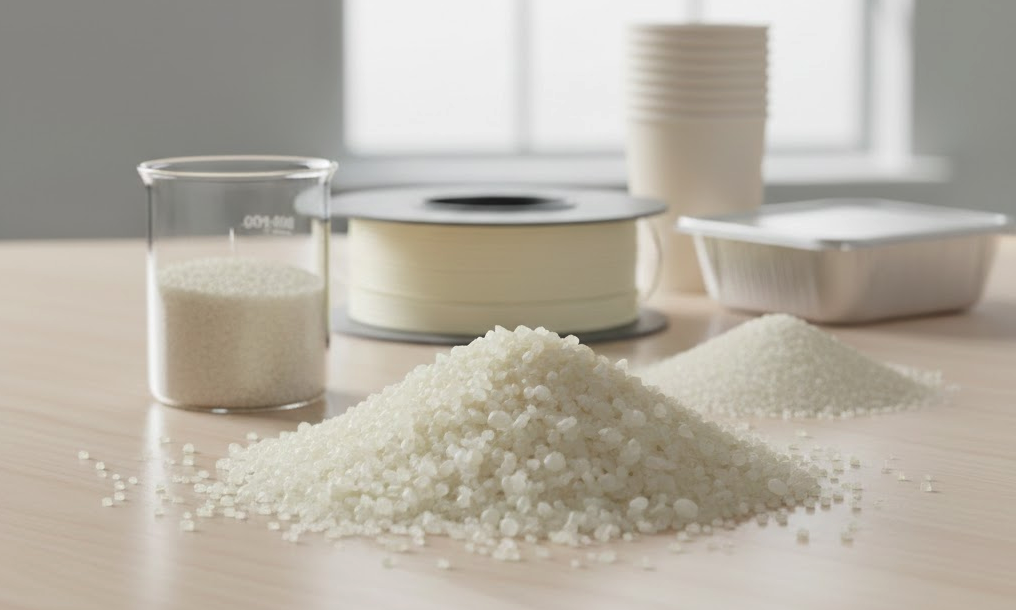
PHA resins
How PHA Is Made
Step 1: Bacterial Fermentation
Specific bacteria strains (like Cupriavidus necator) are placed in large fermentation tanks with plant-based feedstock, typically:
- Vegetable oils (canola, soybean, etc.)
- Plant sugars (corn syrup, cane sugar, etc.)
- Food waste or agricultural byproducts
Step 2: Bacterial Growth
The bacteria consume these plant materials and, as a natural survival mechanism, convert the energy into PHA granules stored inside their cells, especially when under stress conditions such as excess carbon combined with limiting nutrients (nitrogen, phosphorus, sulfur, or oxygen).
Step 3: Harvesting & Purification
After fermentation, the bacterial cells are harvested and broken open to release the PHA granules. The PHA is extracted, purified, and dried into a powder or pellet form.
Step 4: Manufacturing Products
PHA pellets are melted and formed into straws, utensils, containers, and other products using standard plastic manufacturing equipment. The process is similar to traditional plastic production, making it scalable and efficient.
Why PHA Matters for Restaurants
1. Versatile Biodegradation Options
Unlike PLA which requires industrial composting facilities, PHA breaks down in:
- Industrial composting - 90-120 days
- Home composting - 12-24 months
- Soil biodegradation - 12-18 months
- Marine environments - 6-12 months (if it ends up in water)
This flexibility means you can offer genuinely sustainable options to customers regardless of their local waste infrastructure.
2. Superior Heat Resistance
PHA remains rigid up to 140°F, compared to PLA's 110°F limit. This makes PHA straws ideal for:
- Warm beverages up to 140°F
- Hot summer outdoor events
- Transport and storage in warm climates
- Kitchens without climate control
3. Marketing Story Customers Love
"Our straws are made by bacteria naturally converting plant sugars, and they'll break down in your home compost bin" is a powerful narrative that resonates with eco-conscious diners.
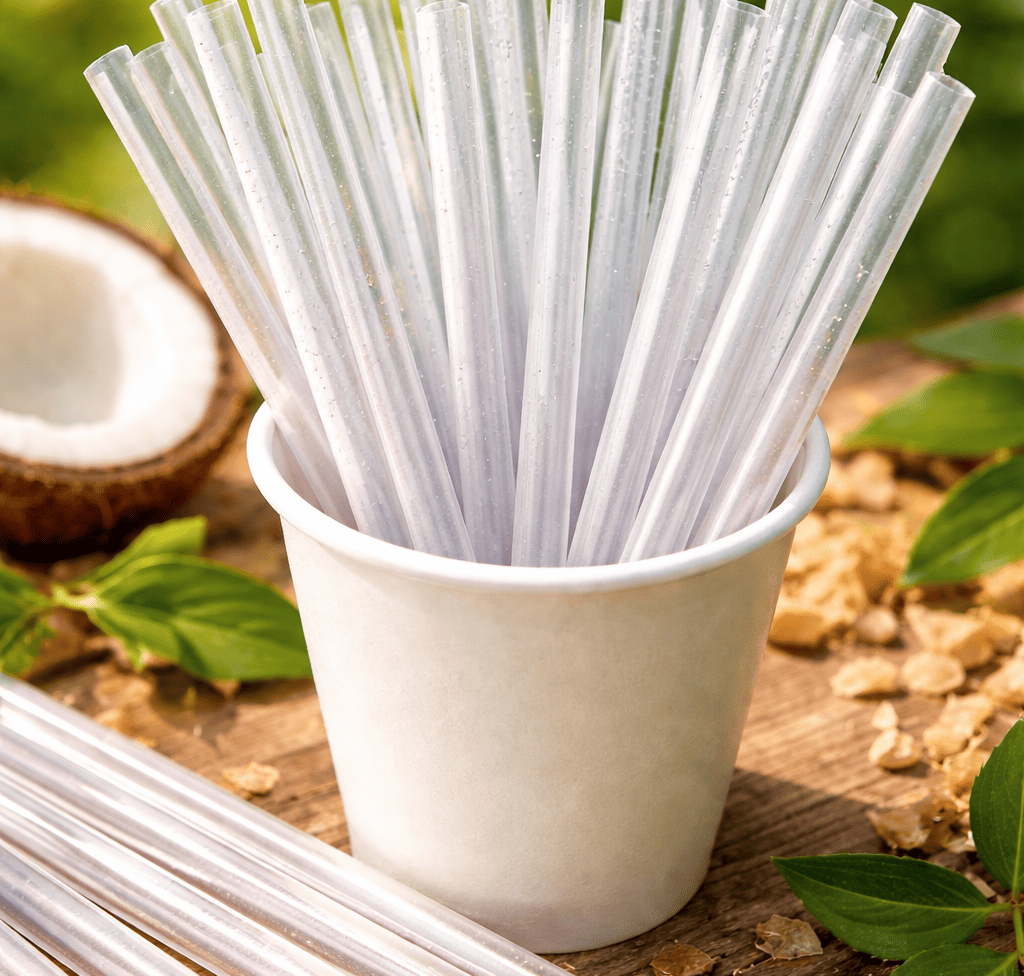
PHA straws
PHA vs Other Materials
PHA vs Traditional Plastic
- Source: PHA from bacteria/plants; plastic from petroleum
- Composting: PHA biodegrades completely; plastic persists for 500+ years
- Microplastics: PHA leaves none; plastic creates billions of microplastic particles
- Performance: Similar rigidity and functionality
PHA vs PLA
- Heat resistance: PHA better (up to 140°F vs PLA up to 110°F)
- Home composting: PHA yes; PLA no
- Marine biodegradation: PHA yes; PLA no
- Cost: PHA higher; PLA more economical
- Availability: PHA growing; PLA more established
PHA vs Paper
- Durability: PHA maintains rigidity 2+ hours; paper gets soggy in 30-45 min
- Customer experience: PHA no taste/texture issues; paper has distinctive taste
- Cost: PHA moderate; premium quality paper comparable
- Composting: Both compost biodegrade in multiple environments
Types of PHA
PHA isn't just one material; it's a family of related polymers with slightly different properties:
PHB (Polyhydroxybutyrate)
- The most common PHA type
- Good rigidity but can be brittle
- Often blended with other PHAs or materials
PHBV (Polyhydroxybutyrate-co-valerate)
- PHB blended with valerate units
- More flexible and less brittle
- Better for products needing some flexibility
PHA Blends & Composites
- PHA mixed with PLA, cellulose, or other materials
- Balances performance with cost
- Optimizes specific properties (strength, flexibility, cost)
Real-World Performance
In Cold Beverages
Excellent. PHA straws perform identically to plastic straws in iced drinks. No sogginess, no softening, no flavor transfer. Customers won't notice any difference from traditional straws.
In Room Temperature Drinks
Excellent. PHA maintains full rigidity and performance at normal temperatures. Perfect for water, juice, and most beverages.
In Warm Beverages (80-140°F)
Very Good. PHA handles warm drinks up to 140°F that would cause PLA or paper to soften. Not recommended for truly hot beverages (above 140°F), but works excellently for warm specialty drinks.
In Hot Weather
Excellent. PHA won't soften during summer transport or at outdoor events. This is a key advantage over PLA, especially for catering, food trucks, and outdoor venues.
Cost & Value Proposition
Direct Cost
PHA straws typically cost 20-40% more than PLA and 30-50% more than basic paper straws. However, they're comparable to premium paper straws.
Value Factors
- Zero customer complaints about sogginess or taste (unlike paper)
- Premium positioning - justify higher menu prices with cutting-edge sustainability
- Broader customer appeal - works for customers with home composting
- Marketing differentiation - stand out from competitors using PLA or paper
- Future-proofing - as PHA production scales, prices will decrease
Experience PHA Straws Yourself
See firsthand why PHA is the future of compostable tableware. Shop our products and test in your operation.
Certifications & Standards
Compostability Certifications
- ASTM D6400 - US industrial compostable standard
- EN 13432 - European compostable standard
- ASTM D5511 - Landfill biodegradation standard
- ASTM D6691 - Marine biodegradable (unique to PHA)
- ISO 17556 - Soil biodegradation standard
- TÜV Austria OK compost HOME - Home compostable certification
Food Safety
- FDA approved for food contact
- EU food safety compliant
- No toxic additives or plasticizers
- Zero migration of harmful substances
Environmental Impact
Production Footprint
- Renewable feedstock - plant-based inputs, not fossil fuels
- Carbon negative potential - plants consume CO2 during growth
- Byproduct utilization - some bacteria use food waste as feedstock
End-of-Life Benefits
- Complete biodegradation - breaks down into water, CO2, and biomass
- No microplastics - unlike traditional plastic that fragments
- Marine safe - won't harm wildlife if it reaches waterways
- Soil enrichment - adds organic matter when composted
Who Should Choose PHA?
PHA straws are ideal for:
- Premium brands - position with cutting-edge sustainability
- Hot climate operations - better heat tolerance than PLA
- Coastal/waterfront venues - marine biodegradable properties
- Eco-conscious customer base - home compostable appeals to this demographic
- Outdoor caterers - won't soften during summer events
- Marketing-focused businesses - unique story drives customer engagement
The Future of PHA
PHA production is scaling rapidly. As more manufacturers enter the market and production volumes increase:
- Prices will decrease - approaching PLA parity in 3-5 years
- Availability will improve - shorter lead times and more suppliers
- Product range will expand - beyond straws to full tableware lines
- Performance will optimize - new PHA blends with enhanced properties
Frequently Asked Questions
Can I really compost PHA straws at home?
Yes, PHA will break down in a home compost bin over 12-24 months. It needs moisture, microbes, and moderate temperatures (not freezing), but doesn't require the sustained high heat of industrial composting.
How long do PHA straws last in storage?
When stored properly (cool, dry conditions), PHA straws have a 2-year shelf life. They won't spontaneously biodegrade. They need active composting conditions with moisture and microbes.
Are PHA straws more expensive than PLA?
Currently yes, typically 20-40% more. However, the performance benefits and marketing value often justify the premium for many businesses.
Can PHA straws be recycled?
No, like PLA, PHA should not go in plastic recycling. It's designed to be biodegraded, which is a good environmental outcome.
How PrairieMate M-Series Enhances PHA
PrairieMate M-Series builds on the advanced PHA platform with proprietary CelluMeld™ enhancements:
- Optimized monomer ratio: We specify exact PHA grades optimized for heat tolerance and performance
- Engineered additive package: Food-safe formulation additives ensure superior structural integrity
- Precision manufacturing: Ohio-based production with systematic quality control and performance testing
- Temperature optimization: Verified performance up to 140°F for warm beverage applications
This is why PrairieMate M-Series delivers consistent premium performance across diverse operating conditions, from hot beverages to outdoor service in warm climates.
Ready for PrairieMate M-Series Straws?
PrairieMate offers M-Series straws in all sizes, powered by CelluMeld™ technology. Experience next-generation plant-based performance with our proprietary PHA-based product line.
Shop Now